- 閱讀權限
- 10
- 最後登錄
- 10-5-2
- 精華
- 0
- UID
- 1381987
- 帖子
- 15
- 積分
- 15
- 註冊時間
- 09-7-15
- 在線時間
- 24 小時

- UID
- 1381987
- 帖子
- 15
- 積分
- 15
- Good
- 0
- 註冊時間
- 09-7-15
- 在線時間
- 24 小時
|
Basically the so-called definition is an iff statement.
Rough idea.
Suppose f is a pointwise limit of f_n, f_n converges to f uniformly if

Negate the statement above, we have f does not converge uniformly on S if

Define

then
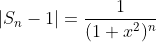
An natural question, does it converge uniformly on R? The answer is no.
Since for any positive integer n (no matter how big), I can take (fixed epsilon < 1)

such that

To avoid the problem (to ensure uniform convergence), we have to avoid having such x. Since uniform convergence cannot take place if x can take an arbitrarily small quantity, then the range |x|>p, p>0 will do!
The sum S(x) will converge to 1 uniformly on any closed inteval [a, b], a>0 or [d, c], c < 0.
Proof.

Since right hand side converges, left hand side converges uniformly.
[ 本帖最後由 Gnoehc 於 10-4-9 12:44 AM 編輯 ] |
|


 發表於 10-4-8 05:15 PM


